

Banyuwangi News – The Javanese people believe that the month of Suro is sacred, marked by mystical, spiritual, and
traditional aspects. The arrival of Suro season—the first month in the Javanese calendar, or a month
of Muharram in the Islamic calendar—became a starting point for many rituals and traditions
performed by Javanese people. Suro is a symbol of harmony between humans, nature, and the
spiritual world reflected in the traditions. These practices manifest differently across the region,
depending on their local customs, histories, and cosmologies. In the village of Barurejo, located in
Banyuwangi, on the eastern coast of Java, the Suro season reveals an understanding of a series of
traditions rooted in Javanese cultural expression.
Suro season in Barurejo begins with the Baritan tradition. This tradition serves as a place for people to
express their gratitude to God and ward off misfortune. The Baritan tradition in Barurejo is highly
influenced by Islamic values, despite Baritan originally being an animist tradition. Baritan started in the
evening, before maghrib time, and took place at every crossroad in each neighborhood. The placement
is based on the Javanese cosmology, where crossroads are considered as a spiritually charged place as
an intersection between the human and the unseen world (dunia mistis). Additionally, it is easier for
people who live nearby to gather at the crossroads. After Asar, people in the neighborhood would
come to the nearby crossroads and sit in a circle on the mat, accompanied by food in a tray or on a
banana leaf from each neighborhood. Later, they start the tradition by praying to God for themselves
and their ancestors for salvation and good luck.
The first ten days of Suro in Barurejo are marked by a social responsibility agenda, which includes the
practice of giving charity to orphans (santunan anak yatim). The date is aligned with Islamic values—
stating that people who have taken care of orphans will receive great rewards and be closer to the
Prophet Muhammad. This tradition has deep roots in Islamic doctrine and history, commemorating
events such as the salvation of Prophet Musa and the Battle of Karbala. Later, these events
acculturated with local wisdom, blending Islamic values with Javanese local beliefs about purification
and protection. Santunan anak yatim is usually held at the village/neighborhood. Days before the
event, the committee will collect funds from the residents surrounding the mosque or religious
organizations, such as Muslimat (a Nahdatul Ulama sub-organization for women). The funds were then
given to the orphans during the event in the mosque. In addition, the ritual also includes prayers and
blessings from the elderly, who wipe their hands on the orphan’s head. This moment is more than
charity; it reinforces the morale of the village, asserting values of solidarity and intergenerational
responsibility.
Another tradition of Suro in Barurejo is Sedekah Bumi. This tradition represents the communal
gratitude to the earth for its fertility and abundance, particularly after the harvest season, which this
year overlaps with the month of Suro. Sedekah Bumi in Barurejo, specifically in Senepolor, involves the
symbolic agricultural products in the form of Gunungan. There were gunungan trucks consisting of
dragonfruit, chili, corn, coconut, chayote, eggplant, rice, bean, etc. Before traveling around Senepolor,
the gunungan are gathered at one point to be prayed over and depart together. Another critical part
of this tradition is Kenduren—a communal meal and prayer ritual that plays a key role in this event.
Kenduren in sedekah bumi offering food, arranged in a tray or banana leaf, for the medium of
thanksgiving and blessing. Kenduren functions as both a spiritual and social act; the participants gather
to recite prayers, often led by a religious leader or a village elder, asking for protection, health, and
harmony with God. They also requested and thanked Dewi Sri, one of the Javanese goddesses who
takes care of the agricultural aspect, to protect their natural resources from crop failure.
After expressing their gratitude in Kenduren, the Gunungan are ready to travel around Senepolor. The
parade started at noon by carrying the Gunungan through the streets of Senepolor. The parade was
accompanied by blasting music, from Hadroh, traditional music, and modern music. People are
excitedly waiting on the roadside while listening to the narrator who is showing their agricultural
products. After traveling around, the Gunungan stopped at one point. Later, people could take the
agricultural products from the gunungan for themselves. This symbolizes equality that all products
given from the earth can be enjoyed and used by everyone.
The last tradition in Suro season is Bersih Desa—a ritual combining spiritual cleansing, social solidarity,
and cultural performance. This tradition is mainly held during the Suro season, or August, before
Indonesia’s Independence Day. Bersih Desa has both symbolic and functional aspects; it marks a
moment of spiritual renewal, aimed at warding off misfortune and reaffirming the community’s values.
The ritual usually begins with doa antar agama, a prayer ceremony held by each religion, such as Islam,
Hindu, and Christianity, on the days before. Later in the day, this tradition begins with Ruwatan, a
cleansing ceremony often involving prayer, a water rite, or symbolic gestures to release negative
energy. In some cases, Ruwatan involves some symbolic acts such as cutting a few strands of hair or
breaking earthenware to signify the release of bad luck (buang sial). In Barurejo, Ruwatan performed
in the afternoon with wayang kulit as a medium fr spiritual cleansing. The narrative commonly used in
Ruwatan is Murwakala, a story about Batara Kala, a fearsome being believed to cause disaster and
misfortune, ancestral curses, or cosmic imbalance. In this context, the dalang (puppet master) plays a
dual role: both as a storyteller and a ritual leader who recites cleansing mantras, prayers for protection,
and symbolic messages believed to hold spiritual efficacy.
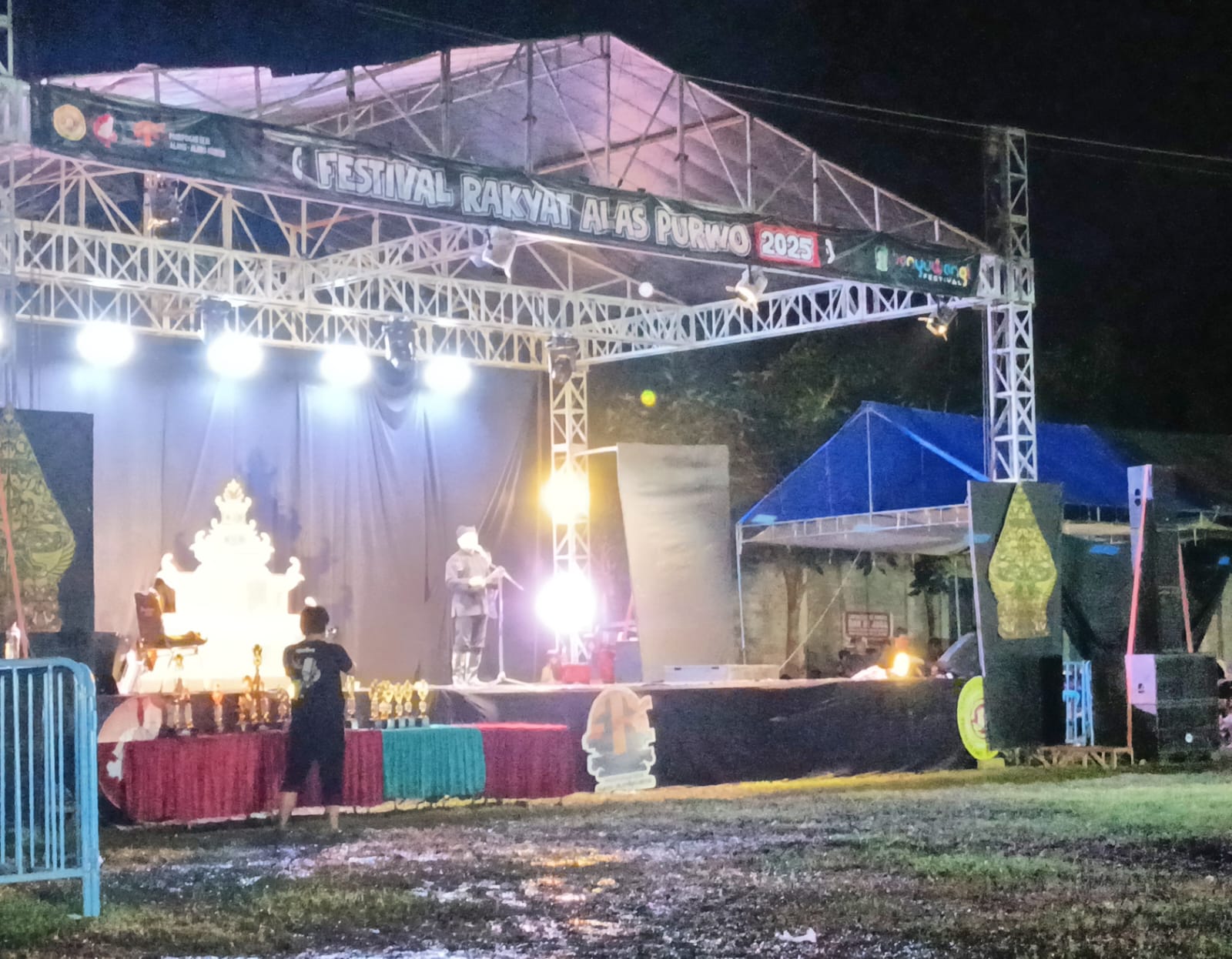
Bersih Desa in Barurejo is more vibrant with the inclusion of traditional art performances, which often
begin in the evening and end early in the morning (wayang semalam suntuk). Wayang Kulit
performance is usually staged with a live gamelan orchestra. The dalang not only entertains the visitors
with a narrative but also conveys moral and spiritual lessons relevant to the community. In addition,
they also performed Banyuwangi’s traditional dance, like gandrung, an Osing ethnic dance, and their
local song. Bersih Desa thus serves as a critical cultural mechanism that sustains the continuity of local
identity while also adapting to contemporary forms of community engagement and celebration. It is
through this culminating ritual that the village symbolically resets itself, reconnecting with the land,
the ancestors, and one another as they move forward into a new spiritual cy cle.
The series of traditions held during the Suro season in Barurejo—baritan, santunan anak yatim,
sedekah bumi, and bersih desa—reflect how the community maintains a strong connection to its
spiritual beliefs, cultural heritage, and social values. These rituals are more than just ceremonies; they
bring people together, strengthen the bonds between generations, and remind everyone of the
importance of harmony with nature, ancestors, and one another. Even as times change, the people of
Barurejo continue to carry out these practices with meaning and purpose, showing that tradition is
not just something from the past, but something that continues to guide and shape the present.
Through these rituals, Barurejo not only honors its history but also builds a stronger and more united
future.
by : : Maybi Fadia M. T


Leave a Reply